
If you’re comparing chacha20 vs aes performance, you’re likely trying to decide which encryption standard delivers better speed, efficiency, and real-world reliability for your specific use case. Whether you’re optimizing secure communications, building an application, or evaluating encryption for constrained hardware, performance differences can directly impact latency, battery life, and overall system stability.
This article breaks down how ChaCha20 and AES perform across modern processors, mobile devices, and hardware-accelerated environments. We’ll examine benchmark data, implementation considerations, and the practical trade-offs that matter most—so you can choose the right cipher with confidence.
Our analysis is grounded in current cryptographic research, real-world deployment data, and documented performance testing across multiple platforms. Instead of vague claims, you’ll get clear, technically accurate insights focused on what actually affects speed, security, and scalability in production environments.
Choosing an encryption algorithm today is as much about speed as it is about safety. AES remains the industry standard, especially with hardware acceleration like AES-NI. ChaCha20, however, shines on mobile and low-power devices where dedicated hardware is absent.
Developers debating chacha20 vs aes performance must weigh context. On servers with modern CPUs, AES can be blazing fast. On smartphones, ChaCha20 often wins in latency and battery efficiency.
Some argue AES is “good enough” everywhere. But bottlenecks compound at scale.
Speculation: As edge computing expands, ChaCha20 may dominate client-side encryption, while AES remains king in data centers for throughput and compliance. Choose strategically.
The Incumbent: Understanding AES and Its Hardware Advantage
To delve deeper into the latest developments and performance comparisons of encryption standards, be sure to check out our Crypto News Feed at Cryptobuzz – for more details, check out our Crypto News Feedcryptobuzz.
So, what is AES? The Advanced Encryption Standard is a symmetric block cipher—meaning it uses the same secret key to encrypt and decrypt fixed-size blocks of data. Adopted by NIST in 2001 after a public competition, AES replaced DES and quickly became the global default for secure data (NIST, 2001).
Now here’s the key differentiator: AES-NI. These are special CPU instructions built into most modern x86 and ARM processors that accelerate encryption at the hardware level. As one security engineer put it, “With AES-NI enabled, encryption is basically free from a performance standpoint.” In other words, the chip does the heavy lifting.
Because of this, AES is ubiquitous, heavily analyzed, and blisteringly fast when hardware acceleration is available. That’s why debates like chacha20 vs aes performance usually hinge on whether AES-NI is present.
Today, AES powers full-disk encryption, database protection, and high-throughput TLS on servers worldwide.
The Challenger: ChaCha20’s Software-First Design
ChaCha20 is a modern stream cipher—an encryption method that secures data one bit or byte at a time—often paired with the Poly1305 message authentication code (MAC), which verifies that data hasn’t been altered in transit. Together, they form ChaCha20-Poly1305, a widely trusted encryption suite.
Back in 2013, when TLS performance on smartphones lagged noticeably behind desktops, ChaCha20 gained traction because it was built for a different world: general-purpose CPUs without specialized cryptographic hardware. Unlike AES, which shines with AES-NI acceleration, ChaCha20 was optimized for pure software efficiency.
This matters in the chacha20 vs aes performance debate. On older Android phones, IoT sensors, and certain microcontrollers, ChaCha20 often outperforms AES due to its resistance to timing attacks and straightforward implementation (fewer hardware assumptions, fewer surprises).
Common use cases include:
- TLS 1.3 connections
- Mobile app encryption
- VPNs like WireGuard
Some argue AES is the gold standard—and with hardware support, it is. But in software-only environments, ChaCha20 remains a formidable challenger.
Performance Benchmarks: A Head-to-Head Speed Comparison

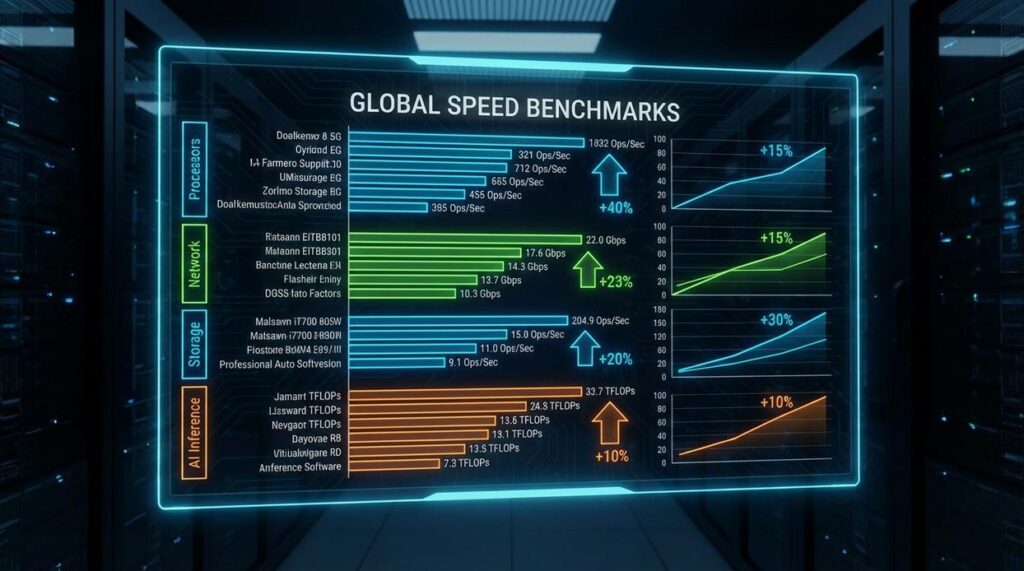
I remember the first time I benchmarked encryption on a production server. We flipped on AES-NI (Advanced Encryption Standard New Instructions, a CPU feature that accelerates AES calculations in hardware) and watched throughput jump almost instantly. In server-side environments with AES-NI, AES routinely pushes 10–20+ Gbps, depending on implementation and CPU generation (OpenSSL benchmarks; Intel performance reports). By contrast, ChaCha20 in the same hardware-assisted environment typically lands lower, often in the 5–10 Gbps range. In other words, when the silicon is optimized for AES, it flies.
However, things changed when I tested older mobile hardware without AES acceleration. On ARM devices lacking AES-NI equivalents, ChaCha20 (a stream cipher that encrypts data one byte at a time) consistently outperformed AES in software-only mode. Measured in cycles per byte—a metric showing how many CPU cycles are needed to encrypt one byte—ChaCha20 often achieves around 3 cycles/byte, while AES software implementations can require 10+ cycles/byte (Google security engineering blog; RFC 8439). That gap matters when battery life and thermal limits are on the line.
Then there’s latency. For small, real-time packets—think messaging apps or VoIP—ChaCha20 can edge ahead because it doesn’t require padding like block ciphers such as AES. Less preprocessing means quicker turnarounds (and fewer awkward buffering delays).
So what’s the verdict on speed? In the chacha20 vs aes performance debate, context is everything. With hardware support, AES dominates. Without it, ChaCha20 often wins. For deeper background, see aes vs rsa understanding the differences in modern encryption.
Cryptographic Security: Are Both Ciphers Equally Safe?
The bottom line? For all practical purposes, both AES-256 and ChaCha20-Poly1305 are highly secure. When implemented correctly, neither has any known practical, real‑world vulnerabilities. That’s not marketing spin—that’s the consensus across modern cryptography research (NIST, RFC 8439).
When people compare them, they often point to theoretical attacks on reduced-round versions. In simple terms, a “round” is one cycle of internal scrambling that makes encrypted data unreadable. Researchers sometimes break weakened, shortened versions of these ciphers—but the full-round versions used in production remain intact. It’s like solving a 10-piece puzzle and claiming you’ve cracked a 1,000-piece masterpiece (nice try).
Where I think the real difference lies is implementation risk. AES can require padding modes—extra data added to fill fixed-size blocks—which has historically led to mistakes like padding oracle attacks. ChaCha20, by contrast, is a stream cipher with a cleaner design, reducing foot‑guns for developers.
Security isn’t just about math—it’s about how humans use it.
Major players like Google and Cloudflare adopted ChaCha20 for TLS, reinforcing its credibility. In chacha20 vs aes performance comparisons, ChaCha20 often shines on mobile devices.
Pro tip: Always prioritize correct implementation over algorithm brand loyalty.
The Final Verdict: A Decision Framework for Your Application
Choosing between AES and ChaCha20 comes down to balancing raw speed, hardware realities, and long-term security guarantees. The core challenge? Delivering strong encryption without sacrificing performance across wildly different devices.
When evaluating chacha20 vs aes performance, the right answer depends less on theory and more on your deployment environment.
Choose AES if:
- Your platform guarantees AES-NI support (common in modern Intel and AMD CPUs).
- You’re optimizing for maximum throughput on servers or high-end devices.
- You benefit from hardware acceleration that dramatically reduces CPU cycles per byte (Intel confirms AES-NI can provide multi‑fold speed improvements).
Choose ChaCha20 if:
- You support low-power IoT, older smartphones, or mixed hardware fleets.
- You want consistent, high performance without specialized instructions.
- You prefer simpler, constant-time software implementations (reducing side-channel risks).
In short: hardware-accelerated environments favor AES; diverse ecosystems reward ChaCha20’s flexibility. Pick what aligns with your real-world constraints—not just benchmarks.
Mastering Modern Encryption Performance for Real-World Security
You set out to understand how encryption performance impacts your systems, scalability, and security decisions. Now you have a clear grasp of how algorithm design, hardware acceleration, and workload context influence chacha20 vs aes performance in real-world environments.
If sluggish encryption, inconsistent speeds across devices, or uncertainty about which cipher to deploy has been holding you back, you’re no longer guessing. You understand where each algorithm excels, how performance shifts between mobile and server environments, and what that means for your optimization strategy.
The key now is action.
Audit your current encryption stack. Benchmark your workloads under realistic traffic conditions. Test both implementations in your specific environment instead of relying on generic assumptions. Performance and security are too critical to leave to theory.
If you want faster systems without compromising protection, start applying these optimization insights today. Thousands of developers rely on trusted, field-tested encryption strategies to eliminate bottlenecks and strengthen data security—now it’s your move.
Run the benchmarks. Optimize your stack. Close the performance gap before it costs you speed, users, or security.
 Jordan K. has opinions about gadget trends and emerging tools. Informed ones, backed by real experience — but opinions nonetheless, and they doesn't try to disguise them as neutral observation. They thinks a lot of what gets written about Gadget Trends and Emerging Tools, Expert Insights, Buzzworthy Data Encryption Protocols is either too cautious to be useful or too confident to be credible, and they's work tends to sit deliberately in the space between those two failure modes.
Reading Jordan's pieces, you get the sense of someone who has thought about this stuff seriously and arrived at actual conclusions — not just collected a range of perspectives and declined to pick one. That can be uncomfortable when they lands on something you disagree with. It's also why the writing is worth engaging with. Jordan isn't interested in telling people what they want to hear. They is interested in telling them what they actually thinks, with enough reasoning behind it that you can push back if you want to. That kind of intellectual honesty is rarer than it should be.
What Jordan is best at is the moment when a familiar topic reveals something unexpected — when the conventional wisdom turns out to be slightly off, or when a small shift in framing changes everything. They finds those moments consistently, which is why they's work tends to generate real discussion rather than just passive agreement.
Jordan K. has opinions about gadget trends and emerging tools. Informed ones, backed by real experience — but opinions nonetheless, and they doesn't try to disguise them as neutral observation. They thinks a lot of what gets written about Gadget Trends and Emerging Tools, Expert Insights, Buzzworthy Data Encryption Protocols is either too cautious to be useful or too confident to be credible, and they's work tends to sit deliberately in the space between those two failure modes.
Reading Jordan's pieces, you get the sense of someone who has thought about this stuff seriously and arrived at actual conclusions — not just collected a range of perspectives and declined to pick one. That can be uncomfortable when they lands on something you disagree with. It's also why the writing is worth engaging with. Jordan isn't interested in telling people what they want to hear. They is interested in telling them what they actually thinks, with enough reasoning behind it that you can push back if you want to. That kind of intellectual honesty is rarer than it should be.
What Jordan is best at is the moment when a familiar topic reveals something unexpected — when the conventional wisdom turns out to be slightly off, or when a small shift in framing changes everything. They finds those moments consistently, which is why they's work tends to generate real discussion rather than just passive agreement.